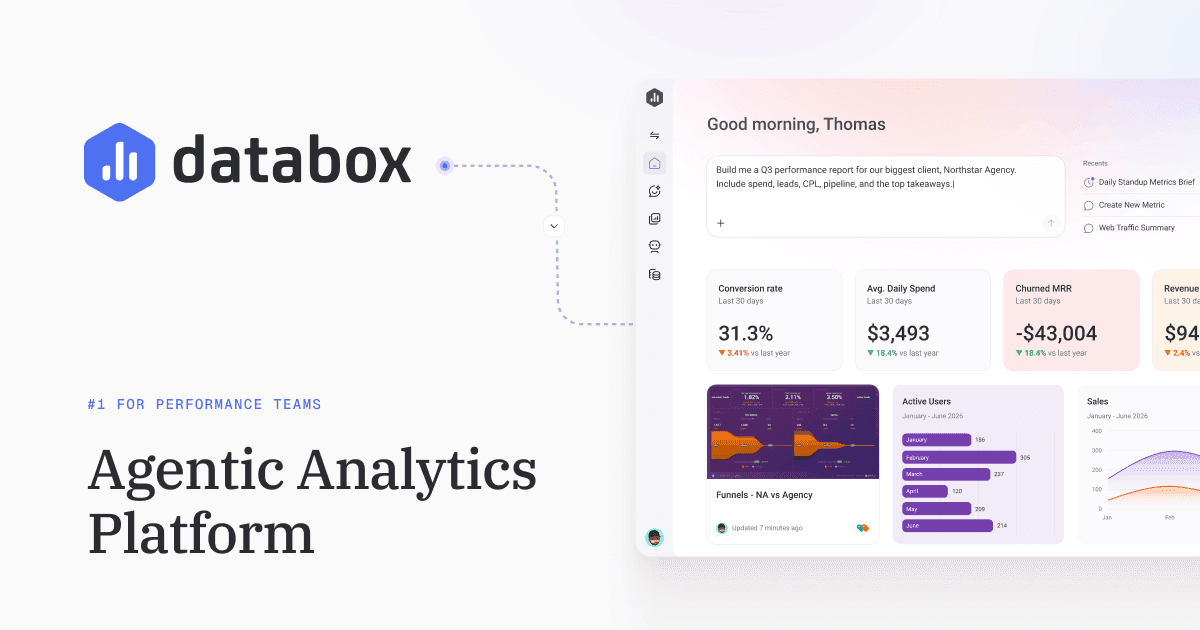
Databox is an agentic analytics platform designed to integrate performance data, business context, and AI workflows for faster action. If your agency or team needs to streamline data analysis, reporting, and monitoring with AI assistance, this platform could be a strong contender. Consider its specific AI capabilities and workflow automation to see if it aligns with your operational needs.
Our Verdict on Databox
Databox appears to be a robust solution for agencies and teams aiming to enhance their data analysis and reporting with AI. Its ability to unify diverse data sources and offer an AI Analyst for plain-language queries could significantly speed up insights and actions. We would recommend Databox if your primary goal is to automate data workflows and leverage AI for performance monitoring and reporting. However, if your team primarily requires basic data visualization without advanced AI-driven analysis or workflow automation, you might find more straightforward alternatives.
Who Databox is Suited For
Agencies and teams that need to consolidate performance data from various sources into one unified platform for comprehensive analysis.
Organizations looking to leverage AI for faster data analysis, report generation, and proactive monitoring of business metrics.
Teams that want to automate entire data workflows, from analysis to reporting, under their oversight using agentic capabilities.
Key Strengths of Databox
Unifies performance data, business context, and AI workflows: Databox brings together disparate data, allowing teams to analyze, report, and act faster with a holistic view.
AI Analyst 'Genie' provides answers with reasoning: Users can ask questions in plain language and receive AI-driven insights that consider metrics, goals, and history, making analysis more accessible.
Automates entire workflows with agents: The platform allows users to hand over complete workflows to AI agents, putting reporting and monitoring on autopilot under human oversight.
Considerations Before Choosing Databox
The platform's focus on 'agentic' AI workflows might be more complex than needed for teams with simpler data analysis requirements.
While it offers thousands of ready-made metrics, the effort required to define and verify custom metrics for specific business contexts should be considered.
The extent of customization for AI agent workflows and the learning curve for setting them up are details to verify before committing.
Important Checks for Databox Buyers
Verify compatibility with your existing data sources and integrations to ensure seamless data consolidation.
Assess the capabilities of the AI Analyst, Genie, to confirm it meets your specific analytical needs and provides actionable insights.
Investigate the level of control and oversight available for automated workflows managed by AI agents.
Check for any pricing tiers or feature limitations that might impact your team's usage, especially for custom metrics or advanced AI features.
Confirm the availability of support resources and documentation to assist with platform setup and ongoing use.
Questions about this find
How does Databox consolidate data from various business sources?
Databox is designed to bring in data from across your business, allowing you to define one trusted version of every metric you track. You can start from thousands of ready-made metrics or build your own, giving each a definition, owner, and verified status.
What is the role of the 'Genie' AI Analyst in Databox?
Genie is your AI Analyst within Databox. It allows you to ask questions in plain language and receive answers with the reasoning behind them. Genie reads your metrics, goals, and history to provide business-relevant insights.
Can Databox automate reporting and analysis tasks?
Yes, Databox allows you to turn analysis into clear, shareable reports, dashboards, or artifacts in seconds. You can also put entire workflows on autopilot by handing them over to agents who will carry them out under your oversight.
About this assessment
Our recommendation weighs the published details against likely buyer needs. It is based on source research, rather than personal testing. Confirm current pricing, availability and terms with the provider.
Read the current provider details.